
Mercy Ships: Charity Rating, Reviews, and the Unfiltered Truth
Mercy Ships: The Numbers Behind the Next Chapter
The maritime sector, for all its hard-nosed commercial realities, occasionally pulls off something genuinely impressive on the philanthropic front. Mercy Ships, the charity that brings hospital vessels to underserved regions, is currently demonstrating this in spades. We're looking at a dual-front expansion: a fundraising drive that’s on track for a new record, and the tangible start of construction for a second purpose-built hospital ship. For an organization operating floating hospitals, these aren't just feel-good stories; they’re critical data points for assessing operational scale and long-term viability.
The Fuel for the Fleet: Cargo Day's Ascending Trajectory
Let's talk numbers, because that’s where the real story lives. Mercy Ships' annual Cargo Day, a unique fundraising initiative within the shipping industry, is poised for its biggest haul yet. Officially kicking off on November 5th and running through year-end, the 2025 campaign has already cleared $1.6 million. Organizers are openly confident it will surpass last year’s $2.2 million, eyeing an ambitious $2.5 million target. That’s a significant leap, representing a potential year-over-year increase of over 13% if they hit their goal.
Since its inception in 2016, Cargo Day has channeled freight commissions, fixture revenues, and direct contributions, accumulating some $15 million—to be more exact, that's the total raised over nine campaigns. More than 150 companies have participated, a testament to the industry’s engagement. It’s worth noting the initiative's genesis: the late Tim Webb of BRS envisioned "Mercy Cargoes," where tanker charterers would offer specific voyages and brokers would donate half their commission, with charterers matching the effort. What started as a niche tanker market idea has blossomed across dry bulk, shipowners, shipbuilders, terminals, and a host of service providers. According to recent reports, Record haul on the cards as Mercy Ships’ Cargo Day builds toward landmark total, the fundraising initiative is building towards a landmark total.
My analysis suggests this isn't just about charity; it's about a highly effective, sector-specific fundraising model. The question I always ask with pledges and targets is: what’s the conversion rate from enthusiasm to hard cash? The public messaging emphasizes pledges, but the true metric is the realized revenue. While the maritime community’s support is clearly robust, the actual cash-in-hand by year-end will be the definitive proof point for this projected record. It’s a bit like watching a stock price climb on analyst upgrades; the real impact is in the earnings call.
Expanding Capacity: The Concrete Reality of Steel and Decks
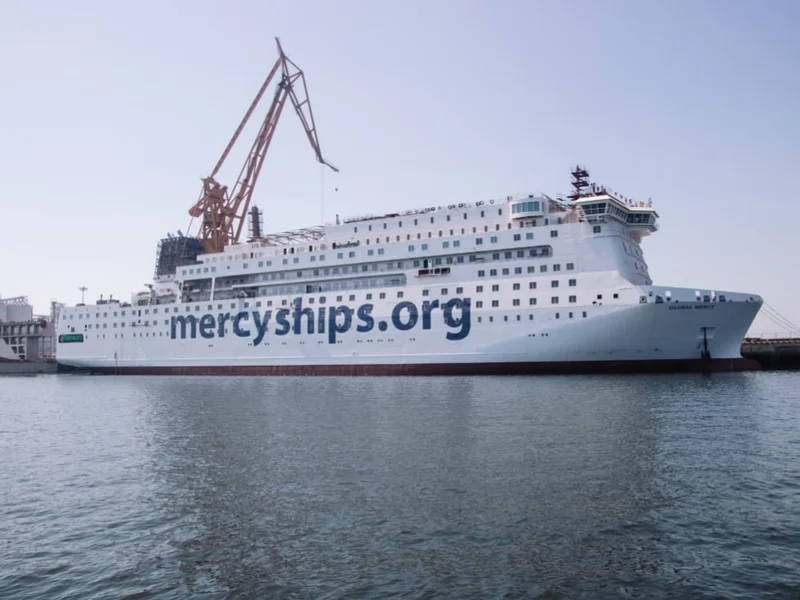
Simultaneously, Mercy Ships is making a substantial physical investment in its future. The steel cutting ceremony for the AFRICA MERCY II newbuilding project took place on October 29th, marking the official start of construction. Steel cut for Mercy Ships second new purpose-built hospital ship - DredgeWire covered the event. This isn’t a small undertaking. Once completed, this vessel will be one of the world’s largest civilian hospital ships, measuring 174 meters in length, 28.6 meters in breadth, and boasting 12 decks. It's designed to house up to 644 volunteers and medical professionals, with six operating rooms, 98 acute care beds, 86 low care beds, and seven ICU/isolation beds. These aren't just numbers; they represent a dramatic scaling of operational capacity for a mercy ships charity.
I've looked at expansion plans for numerous NGOs, and the logistical leap required here is genuinely substantial. The AFRICA MERCY II will be a sister ship to the GLOBAL MERCY, which was delivered in 2021. This means Mercy Ships will soon operate two massive, purpose-built hospital ships, alongside the existing AFRICA MERCY (a converted ferry that’s been in service since 2007). The ceremony itself, with a tree planting at Tongzhou Forest symbolizing growth before the first cut of steel, offers a vivid detail of the intentionality behind this expansion. Robert Corley, COO of Mercy Ships, initiated the steel cutting, surrounded by partners like GSI and MSC Group, the main sponsor. This isn't just a new ship; it's a new enterprise, a floating medical complex requiring immense coordination and sustained funding.
The crucial questions here shift from fundraising to operational overhead. How many mercy ships are there currently, and how will this new addition impact the overall deployment strategy? With the AFRICA MERCY II joining the fleet, Mercy Ships will effectively have three operational hospital ships, significantly bolstering their presence in mercy ships africa. The cost of running one such vessel is astronomical; running two purpose-built giants, plus a third, demands a continuous, robust financial pipeline. This isn't just about construction costs, which are substantial (MSC Foundation is the main sponsor, for instance), but about the long-term, year-in, year-out operational expenditures. Recruiting and retaining the hundreds of mercy ships volunteer staff required for these vessels will be a continuous challenge, regardless of how good a charity Mercy Ships is perceived to be. The training programs for African healthcare workers, while vital for long-term capacity building, also add to the ongoing investment. It’s a massive, multi-faceted logistical puzzle, and the success of Cargo Day becomes even more critical in this context.
The Scaling Equation: Aspirations Meet Operations
Mercy Ships is clearly in an expansion phase, leveraging strong industry support to build out its physical assets and projected service delivery. The current Cargo Day momentum suggests the financial engine is humming, at least in terms of pledges. The steel cutting for AFRICA MERCY II confirms that these aspirations are being translated into concrete, tangible infrastructure. The challenge, as always, lies in the sustained execution – converting those pledges into consistent operational funding, and then seamlessly integrating a massive new asset into an already complex global medical mission. It’s a high-stakes game of supply and demand, where the demand is for critical medical care and the supply relies on the generosity and logistical prowess of a global network.